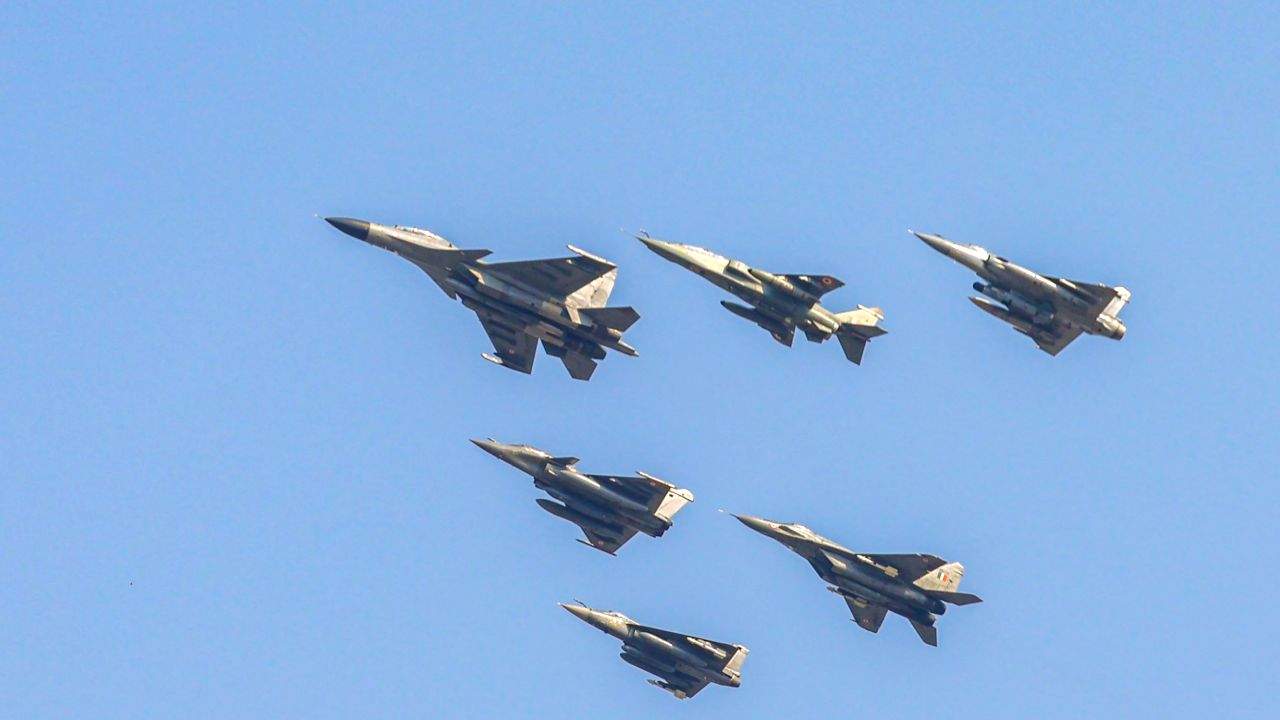
October 26 : Varanasi: On Sunday, the skies over Kashi, the city of Baba Vishwanath, witnessed not only the might of the Indian Air Force but also glimpses of India’s rich cultural heritage. The ‘Wings Over Ganga’ air show brought together Indian traditions, spiritual consciousness and the resolve to defend the nation. As Indian Air Force aircraft roared over the Ganga, names such as ‘Omkar’, ‘Rudra’, ‘Bhagirathi’, ‘Tridev’, ‘Mahadev’, ‘Vishwanath’ and ‘Neelkanth’ resonated across the skies, lending a distinct identity to Kashi’s cultural and spiritual heritage.
Organised to mark the 94th anniversary of the Indian Air Force, the event featured 25 special aircraft formations. Their names drew inspiration from Kashi’s identity, religious beliefs, mythological figures and sacred rivers. Beyond their cultural significance, each formation showcased a distinct aerial manoeuvre.
In the ‘Omkar’ formation, three Mi-17 V5 helicopters flew carrying the National Flag and the Indian Air Force flag, while flowers were showered from three Chetak helicopters in the ‘Ganga’ formation. The ‘Rudra’ formation, inspired by a manifestation of Lord Shiva, featured the Sukhoi-30 MKI. In the ‘Bhagirathi’ formation, indigenous Light Combat Helicopters and Apache helicopters flew in a diamond formation, while ‘Tridev’ brought together helicopters from the Indian Army, Navy and Air Force, showcasing coordination among the three services.
Names associated with Lord Shiva and Kashi’s religious identity also left a distinct impression in the skies. The ‘Kailash’ formation featured Chinook and ALH helicopters; ‘Bhairav’ included C-295 and Dornier aircraft; ‘Trilochan’ featured an AEW&C aircraft alongside MiG-29s; ‘Nataraj’ brought together the Navy’s P-8I and Mirage-2000 aircraft; and ‘Mahadev’ featured an IL-78 mid-air refuelling aircraft accompanied by three Mirage-2000s. Three Sukhoi-30 MKIs flew in the ‘Vishwanath’ formation, four Jaguars in ‘Pashupati’ and three Rafale aircraft in ‘Neelkanth’.
Thus, names associated with Lord Shiva, the revered deity of Kashi, were brought together with displays of modern fighter aircraft and advanced military technology.
The air show also featured formations named after regional and mythological heritage. In the ‘Kashi’ formation, three Kiran aircraft flew in a ‘V’-shaped formation, symbolising victory, while painting the colours of the Tricolour across the sky. The ‘Varun’ formation demonstrated the capability of helicopters to lower personnel using ropes. Rafale aircraft in ‘Kedar’, Sukhoi-30 MKIs in ‘Hanuman’ and the historic Harvard aircraft in ‘Sarnath’ showcased their flying skills in distinctive styles. The ‘Alaknanda’ formation featured Chinook and ALH helicopters, while in ‘Dashashwa’, a C-17 Globemaster led the nine-aircraft Hawk formation of the Suryakiran aerobatic team. The indigenous Tejas showcased its aerial capabilities in the formation named ‘Assi’.
The names of these formations are rooted in Kashi’s religious and cultural identity, the sacred rivers of the Ganga and the Himalayas, mythological traditions and local heritage.
‘Omkar’ evokes spiritual consciousness, ‘Bhagirathi’ recalls the tradition associated with the descent of the Ganga to Earth, ‘Tridev’ represents the concepts of creation, preservation and destruction, while ‘Neelkanth’ recalls the benevolent, welfare-oriented form of Lord Shiva. Names such as ‘Vishwanath’ and ‘Pashupati’ reflect the wider religious traditions associated with Lord Shiva.
Tejas showcases the strength of Aatmanirbhar Bharat
As the indigenous fighter aircraft Tejas demonstrated its speed, agility and remarkable combat capabilities in the skies, the atmosphere filled with pride in India’s growing strategic strength and self-reliance. Tejas showcased the Indian Air Force’s operational capabilities and the growing role of defence technology developed in India.
The aircraft’s thrilling manoeuvres sent a clear message that India is continuously strengthening its capabilities in the defence sector. Its precise turns, rapid changes in flight direction and spectacular aerobatic displays enthralled spectators.
The performance not only highlighted the courage and skill of the Indian Air Force but also symbolised India’s growing confidence in indigenous technology.
The roar of Tejas demonstrated that India’s defence strength rests not merely on state-of-the-art aircraft and military expertise, but also on domestically developed technology, research and manufacturing capabilities.


